Understand your options
How to Read Food Labels for Allergens and Safety
Learn how ingredient names and allergen statements work together on packaged foods, with a practical reading routine and FDA food-handling guidance.
4-minute read · Published Sep 28, 2026 · Sources checked Nov 12, 2026

The essential idea
Food labels can help you identify ingredients and allergen statements before you buy or serve food. Read the ingredient list and any “Contains” statement together, then check the package’s storage and handling instructions. This is a practical reading habit; a label cannot decide what is appropriate for someone with a food allergy.
Start with the complete ingredient list
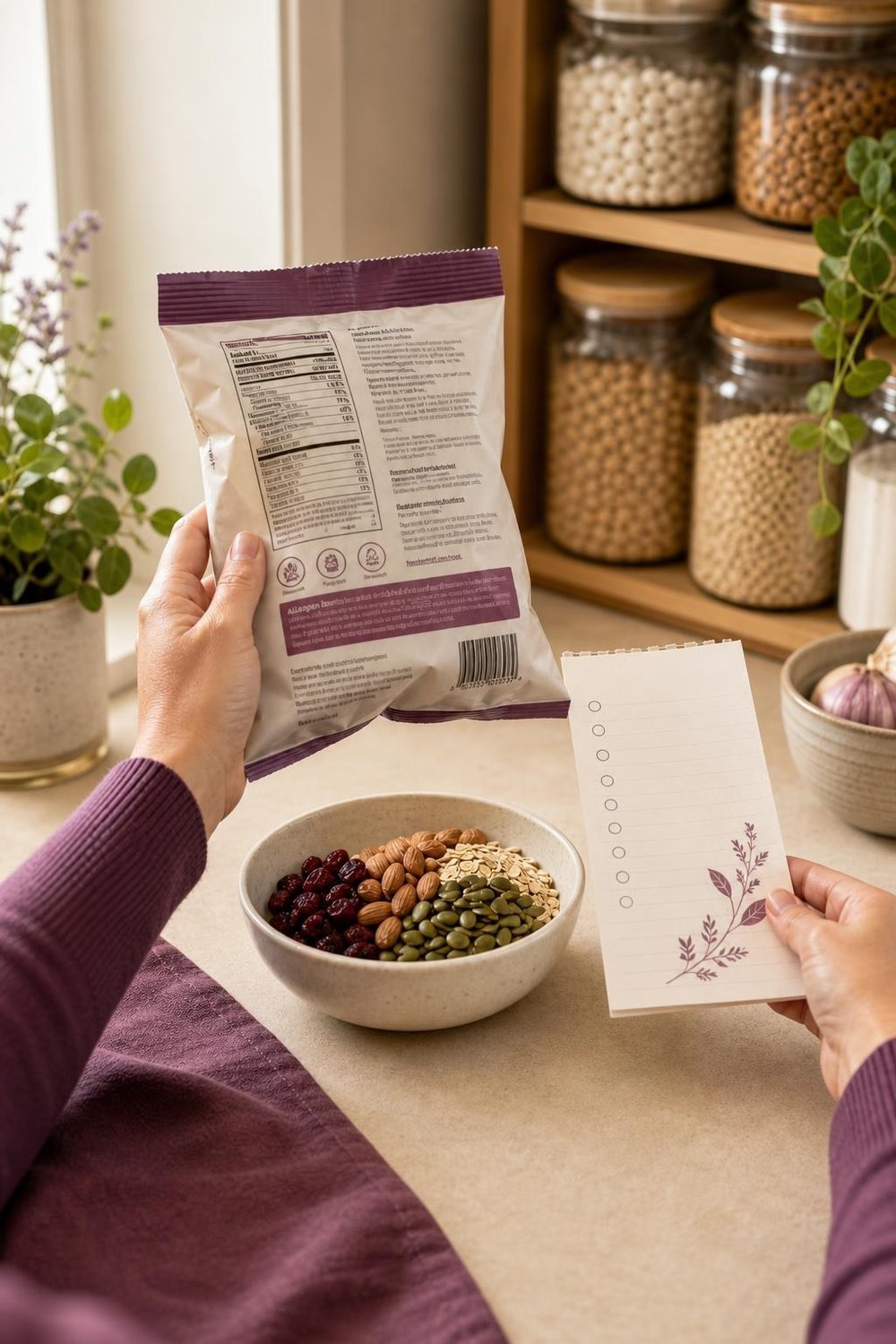
A front-of-package description is only a starting point. Turn the package around and find its ingredient list and allergen information before deciding what to bring home. Keeping the complete package available can also help when you are preparing food for someone else and need to show them exactly what it contains.
FDA’s allergen guidance explains that the food source of a major allergen must be identified on the foods covered by its labeling rules. That information can appear within an ingredient’s name, in parentheses, or in a separate statement. Read the actual wording instead of assuming that a familiar product name tells the whole story.
Recognize ingredient names and food-source names
Some ingredient names already identify their food source. FDA gives buttermilk as an example of a name that identifies milk. Other names may be followed by a food source in parentheses; examples in its guidance include lecithin (soy), flour (wheat), and whey (milk). These examples explain how the label communicates an allergen, rather than creating a complete list of ingredients to avoid.
A separate Contains statement is another way the major allergens can be identified. Do not assume a product lacks allergens simply because there is no separate statement: the relevant food-source name may already appear in the ingredient list. If the wording is unclear for your circumstances, ask a qualified professional rather than guessing.
Use allergen statements together with ingredients
FDA labeling rules require major food allergens to be identified clearly on regulated foods. The major allergens include milk, eggs, fish, Crustacean shellfish, tree nuts, peanuts, wheat, soybeans, and sesame.
Look for allergen disclosure in parentheses after an ingredient or in a separate “Contains” statement. Reading both locations matters because the same allergen may appear in either place depending on how the label is written.
Check storage, cooking, and handling details
Food labels can also support safer handling at home. Some packages include instructions for refrigeration, reheating, or preparation, and those directions are worth following closely, especially for perishable foods.
FDA food-safety guidance also emphasizes clean, separate, cook, and chill. That includes washing hands and surfaces, keeping raw meat and eggs apart from ready-to-eat foods, cooking foods to safe temperatures, and refrigerating perishables promptly.
Build a simple label-reading routine
A practical routine is to check the ingredient list, identify any declared allergen food sources, and read any separate Contains statement. After that, review storage and heating instructions before putting the item into your cart or pantry. Keeping that order consistent can make the task easier to repeat.
This approach is useful for packaged meals, snacks, baking mixes, and condiments. It keeps the focus on the facts printed on the package rather than assumptions based on the front label alone.
Common questions
What is the most important part of a label for someone with food allergies?
The allergen statement and ingredient list are both important. FDA labeling requires major allergens to be identified clearly, either in parentheses after the ingredient or in a separate “Contains” statement.
Does every package need a separate Contains statement?
FDA describes more than one way to identify major allergen food sources. A source may already be clear from an ingredient name or may be given in parentheses after an ingredient. A separate Contains statement is another option, so its absence is not proof that the food contains no allergens.
Should I also check handling instructions on the package?
Yes. Package directions can include storage, reheating, or preparation guidance, and FDA food-safety advice also recommends prompt chilling, clean surfaces, separation of raw and ready-to-eat foods, and proper cooking.
Continue exploring
Explore current semaglutide options
See the current product listings, source links and verified pricing in the live comparison.
View semaglutide pricing ↗Sources & further reading
Prepared with AI assistance and automated source review. This article has not been reviewed by a clinician.
Educational information, not medical advice
This article is for general educational purposes only and is not medical advice, diagnosis or treatment. RightFit Health is an informational publisher, not a healthcare provider or pharmacy. Always consult your doctor or another qualified healthcare professional about medical questions and before starting, stopping or changing any medication. Never disregard professional medical advice or delay seeking it because of something you read here.
Save this article for later